Tuesday, October 30, 2012

Q&A with Dave Chameides

Do you remember the first time you saw or heard of the Steadicam?
I was in school at NYU working as an AC on a "feature" called Crawdaddies in upstate NY. Horror movie, no pay, mud, sleeping on the ground if we did, ahh the glory of youth and being a filmaker. Anyhoo, this guy named Bob Fiske who I am still friends with came out with this contraption he had built out of things he had lying around the house that he called a steadicam. The center post was a paint pole, the remote was literally a return mechanism from a vcr. I don't recall what the arm was made of but the vest was made from foam and old plastic 5 gallon buckets. It was wild, it worked (to a degree but at the time seemed amazing) and I was hooked. The first time I saw a real one was a spec spot that Kirk Gardner was on. He had a 3 (or maybe a 3A) and blew me away with it. I recall him letting me try it on and thinking that was about the coolest thing in the world! And it was.


What was it about the Steadicam that made you want to pursue it as a career?
Can't really say, but something clicked. I just knew that's what I had to do. I think it's the idea that it's a specialty, it's not easy, and most importantly, when that camera rolls (remember when cameras actually rolled?) you're on and it's make it or break it. As I got into more and more interesting shooting situations I recognized how much creation is involved with being a Steadicam op, meaning actually molding the shot, and have loved that aspect ever since, but I can't say that was part of the original thought processes.

And then of course there are the women.....


What were you doing prior to Steadicam?
I was a first AC on low budget straight to hand puppet theater movies. Even got to do a few Corman gigs before they closed shop. That was a place indeed. I was in school when I first saw the noble beast (or a version thereof) and moved out to LA the following year.


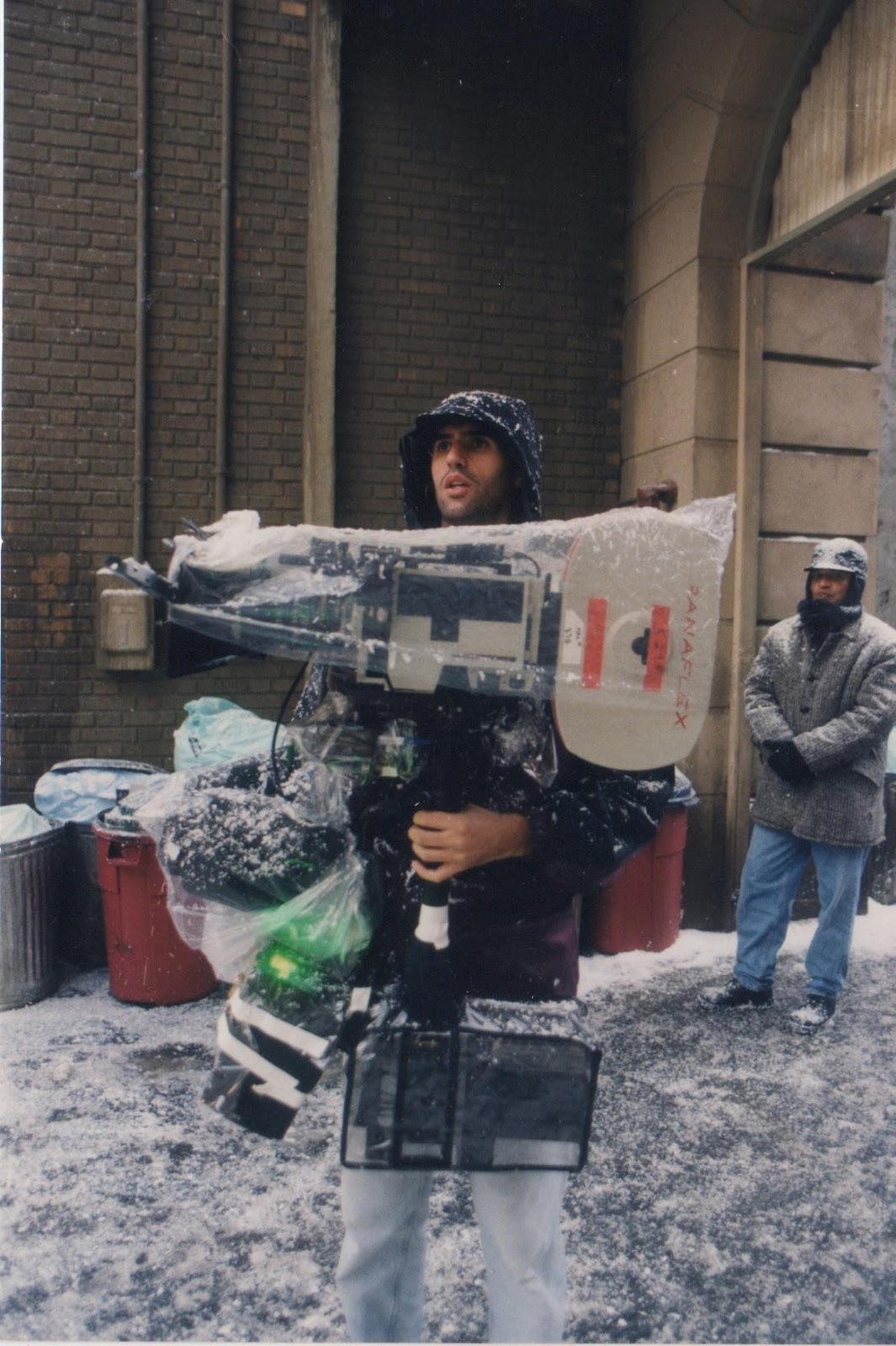
With a Steadicam Model II, on set of Bitter Harvest
What were some of the biggest challenges you remember about becoming a Steadicam operator?
Umm, walking, panning, tilting, starting, stopping, standing still, standing up, and of course, soldering wires in between shots. I know that sounds crazy but it seriously was.

I took an EFP workshop down in Santa Monica that was a three day weekend thingamabob that Ken Ferro and two others (can't recall who....James Livingston maybe) taught. I flew back east the next night and actually brought a cardboard paper towel tube with me to the airport to "practice" panning the rig. That's how nuts I was. When I got my first rig, a model I serial number 22 (nicknamed Old Smokey) I spent about a year running around my apartment building with it because I couldn't make the stupid thing do anywhere near what I wanted to make it do. So I just kept hammering away, hours a day until I was able to do at least something decent with it. I do recall how totally overwhelming it was and how much I wanted to be in the rig for 20 hours straight to figure it all out but how much my body hurt and I couldn't be. Sort of an addiction now that I look back.  I probably could have used some therapy.


What are some of the biggest challenges now?
I'm 43 and i've been an owner op for just about 20 years. I'd say the toughest thing now is rebounding. I remember the days when I would triple book and do 36 hours of operating, sleep five and then get up and do running shots and love it. Now the rebound after a long day is tough.

I've also found that what I enjoy has changed. For a while it was "who can do the longer shots with no cuts" and I was truly blessed with ER, West Wing and others to get a lot of chances to do some cool long stuff. Now though I'm much more interested in the slower finesse moves. Landing perfect lockoffs, timing pans, etc. But I digress.

What was the question again?

I think the other challenge that's odd to me is that we are back to either super heavy or super light cameras. When we started there were just a few Steadicam cams and I remember more than once flying Golds with Primos on a model 1! Craziness. But then the lightweights came out, the Arricams, etc. Now we are in this digital age where things are either 70 pounds or two. It's weird and I miss the days of showing up and not even having to think about the build because it was a Pana Lightweight or something I'd flown 5000 times. Now it's a new camera every week and we are always having to reengineer, rethink, get new plates, etc. One step forwards two steps back. Or something like that.


Dave's first day on set of ER
Did you ever have a "big break' moment? A career event that clearly changed or paved the way for everything to follow?
Without a doubt that was ER for me. I did a cross country bike trip for charity the first year ER came out and I had no idea what it was. I remember being in Who Knows Where, Indiana and the black and white TV was on, coming in and out, and there was a medical drama on. I was half watching it and the antenna was not very good so it sort of came in and out, but at one point remember thinking "holy crap that shot is still going" and no one knowing what i was talking about.

I got back to LA and used this new thing called email to send a message to Guy Bee (who I didn't know) telling him how amazing the work he was doing was. I think nowadays we take it for granted but he was doing stuff on a daily basis that a lot of us only dreamed of. We corresponded for a bit and then one day he called for me to fill in for him which totally shocked me (thankfully I didn't have to wear the pants though). I did one day, didn't do much Steadi and the DP operated A, but was out of my mind with excitement. When he left the show after the second season, they called and gave me the shot and I jumped.

I literally spent the first month of that show thinking that I was going to get fired everyday because I was so far in over my head. But they kept on throwing my name on the call sheet and before I knew it, I had settled into it. While there are other shots and other shows that people seem to mention and like, ER was definitely the highlight for me. I was 25 when I started and it took me more places and gave me more experience than I could have possibly understood it would at the time.

And while I'm on ER, I would be remiss if I didn't throw a huge thanks out to my assistant Terrance Nightingal who carried me through those early times. He was a great AC and is now a great Steadicam op in his own right.


From whom do you take your inspiration? Has that changed over the course of your career?
It'd be stupid for me not to say Garrett because that's a no brainer. He's always been up there for obvious reasons. After that I'd say someone who most people may not even know, the man who taught me how to operate, Bob Crone.

When I took the masters class at Calamigos, Bob was the lead instructor. I can honestly say, he was one of the kindest, most patient people I've ever met in this biz. I'm going to guess that Bob was close to 60 at the time and he never put on the rig. As we'd head back to our rooms at night we'd joke that maybe he couldn't fly the rig anymore, etc etc. But then when it came time to do the Gran Prix shot, Bob put a 3A on to demonstrate it and to this day I have never seen anyone more elegant or excellent in a rig. He moved effortlessly, like a cat and even sitting here twenty years later, I can still feel the awe I felt back then.
One night Bob told us, in his quiet Canadian way, that the odd key to our job is that if we were to do it well, no one would ever notice that we had done it at all. I've taken that to heart all these years in how I operate and (hopefully) in how I conduct myself on set and have always thought that if I can become even half the operator he showed us to be then, I'd be happy.

Great man, great op.


Is there a shot, film, or moment in your career that you can think of as your most proud?
There's some pretty good stuff in ER I'm happy with, but ironically not the stuff most people think of. I remember one shot which was just a move in a door, a push in to two actresses and then a slow pull back. The whole thing was probably 100 feet of travel and it lasted about a minute and a half so it was painfully slow. I recall really being proud of that one.

I've always liked the stuff I did on Donnie Darko, but more for how it plays than the operating, and I just did some stuff on Shame last year that I thought was fun.

Mostly, I hate the stuff I do, so it's kind of hard to come up with stuff I like. Incidentally, my static reel is about 4 hours long now though and really rock solid. Sure anyone can move with this thing, but how many can stand perfectly still for 4 minutes after a 3 foot move. That's talent.


Is there a shot or film you can recall as being your most challenging? Why?
They all seem to be in their own way, but there is a shot in The West Wing on an ep called 5 Votes down. I won't recount it here because I think I wrote about it on the site already but three sets of stairs (one backwards) 3 plus minutes covering lord only knows how much distance, and keeping track of about 10 actors dialogue and when to cue on and off of them. It was a rough one, but came out quite nicely. 16 takes as my back can recall.


What work of your peers do you admire?
I know it's an obvious choice but I've always loved Larry's work of course. Jim Muro back in the day pulled off some great stuff and as I mentioned Bob Crone. Guy Bee has some great shots and left me some seriously huge shoes to fill. I think Andrew Mitchell does some amazing work on Glee and I can recall quite a few shots by Chris Haarhoff that I was totally blown away by. My good friend Charles Papert has done some really nice work over the years and I was always impressed with his ability to dissect a shot and break it into it's pieces. I was lucky enough to have him operate for me when I first directed and it was so great to have someone of his caliber have my back and turn in such great stuff.

It's funny though because there are a few names that everyone knows who they probably cite over and over, because of the high profile nature of their work and also their abilities. But that said, there are so many ops out there churning out solid work day after day who rarely if ever get any mention at all. Why? Because they are doing good work and as a result, like Bob Crone said, no one knows they are even doing it.

Somewhere right now, some op we may not have ever heard of is in hour 16 and has done 22 takes of a huge shot that he's nailed 19 times. He's a dayplayer and has to be on another set in 11 hours, has a 30 minute wrap ahead of him, and an hour drive after that. He's sweaty, dead tired, hungry, pissed off at having to remind the lead that she needs to find her light when she turns that fourth corner, and is wondering why the director is getting all the glory when he basically put this shot together. Oh, and one of his cables was just crushed by the DIT. But with all that, when they call "going again" in a minute, he'll brush all that off, pick up the rig, call out ready in a mildly irate tone, and then flawlessly nail take 23.

That's the op I admire most.


Many people will say they've tried on a Steadicam once, and immediately thought, "absolutely not." What do you think is different about those of us that say "absolutely"?
We're all crazy.

Wednesday, February 22, 2012

Q&A with BJ McDonnell, SOC

Do you remember the first time you saw or heard of the Steadicam?
The first time was watching Aliens and seeing the arms used to mount Vasquez rifle. I was so intrigued by this and I couldn't stop drawing them in art class. I then found out what it was after watching behind the scenes of movies growing up.

What was it about the Steadicam that made you want to pursue it as a career?
I love framing shots and telling a story thru movement of the camera. I started my film career as a grip / dolly grip. I loved working with the operators and really felt as though I was a big part of the filming process as a dolly grip. I needed more. I decided to pursue a career as a camera operator and the rest is history.

What were you doing prior to Steadicam?
I toured with a punk band for 6 years of my life, then became a grip.

What were some of the biggest challenges you remember about becoming a Steadicam operator?
Getting the D.P.s who knew me as a grip to take me seriously as a camera operator. Also climbing the ladder to be taken seriously as a camera operator. There are alot of people trying to do this as a career.

What are some of the biggest challenges now?
I think the biggest challenges now are with HD shooting. It seems as though when with film there was a art to the film process. With HD nobody wants to cut cameras and as a steadicam operator it calls for more endurance for longer takes.
Also the fact that more people are lowballing and making it harder for steadicam rates to stay up.

Did you ever have a "big break' moment? A career event that clearly changed or paved the way for everything to follow?
My big break in Features came from my friend and D.P. Phil Parmet. He always believed in me and he brought me on to be the B operator / Steadicam on Halloween. He is a true bad ass and great friend.
My T.V. break came from D.P. Charlie Lieberman. He hired me to do a T.V. show called Standoff which later took me to do season 2&3 of Heroes

From whom do you take your inspiration? Has that changed over the course of your career?
My Grandfather has always been my inspiration for the film industry. He was a actor and I was so amazed by the whole process of storytelling thru film. He paved the way.

Is there a shot, film, or moment in your career that you can think of as your most proud?
I did a shot in a film called Shrink a very long steadicam ONe take shot. Loved that shot. It timed out longer than the infamous goodfellas shot lol.

Is there a shot or film you can recall as being your most challenging? Why?
Battle: Los Angeles has got to be the most challenging film I've done. It was physically brutal. Steadicam was always comprimised by flying under helicopters etc... It was mostly handheld and it was just a really tough film. Im proud of it. Watching it you can easily say, "That was a bitch to make" lol.

What work of your peers do you admire?
Jimmy Muro, Charles Papert, Dave Emmerichs, Larry McConkey, etc....and I could name so many people. Honestly I admire almost all steadicam ops out there because there is a certain passion we all share for the craft.

Many people will say they've tried on a Steadicam once, and immediately thought, "absolutely not." What do you think is different about those of us that say "absolutely"?
When I first put on a rig I almost said "Absolutely not". I loved it so much I trained myself and muscles to be able to handle it. I say for those who say "Absolutely not" to not give up that easily. Like anything it takes practice. Learn the tool, love the art, know framing for the story you are telling because they can all range in different looks, and last just have fun because you are making a movie.


BJ's website can bew viewed here: www.mcdonnellsteadicam.com

Thursday, May 12, 2011

The "Big" Rig Dilemma

In the few years since I decided that I wanted to pursue Steadicam as a career, I’ve spent a lot of time trying to figure out what direction I wanted to go in, gear-wise. I’ve poured over countless rigs, new and used, read every review I could get my hands on, looked through pages upon pages of posts over on the Steadicam Forum, and done more business planning and financial hand-wringing as is probably sane for a person of my age. This is a struggle that I’ve seen many new operators go through recently – there’s a plethora of gear out there right now, and much of it is coming down in price. Also, with changes in modern production (lighter cameras, new video technology), it’s become increasingly tempting to pick up lighter-weight rigs, which cost significantly less.

So, how did I pick what range of rig to buy? It’s a long story, but it boils down to a simple point - I never wanted to turn down a job because my rig couldn’t do it.

I had owned a lightweight rig for a few years, and not only was I not taken terribly seriously by anyone who knew their equipment, but I also had to be very careful before applying for jobs. I never knew when a DP would ask me to put an extra accessory on the rig that would take me over my meager weight capacity. It’s not a good situation to be in!

Additionally, I found a big bonus to buying bigger, and it’s something I never would have believed until I got the rig. The bigger a rig is, the more stable it is. It’s a simple point of inertia – the formula for the inertia of an object is its mass times the velocity it is traveling at – thus a heavier rig has more inertia than a lighter one, assuming both are doing the same shot. More inertia means that the rig requires much less “babysitting” from the operator, allowing more focus on fine control. It’s a big, big improvement.

Finally, I had to work out what age of gear I was comfortable with. In my situation, it made much more sense to buy a bit older, and get a rig that could actually do everything I wanted. After looking at it, and realizing that I had a lot left to spend outside of the rig, I decided to go for the rig I have now, a PRO I, which allowed me to focus more budget on accessories. Even something as small as cables can add up quickly, when for every cable, you need a spare. On a set, I know I’d rather have a whole bag of spare cables (like when a PA dropped the monitor off my rig a few weeks ago and tore a cable in half) than a flasher, newer rig.

Finally, the dilemma is solved – big rig it is. Now to get back to practicing for the next shoot!

Wednesday, May 4, 2011

Q&A with Christopher TJ McGuire

Do you remember the first time you saw or heard of the Steadicam?
'Rocky'! .... The inspirational film that motivated most of my Teenager years - I first spied Mr Garrett Brown ringside with the Rig that would change my life!

What was it about the Steadicam that made you want to pursue it as a career?
I was an Athlete at school following on from my Dad - I trained pretty much most of the time and loved the 800m and High Jump - so it was either a job in the Royal Marines or a career pursuing my dream of working in the movies. Steadicam, ultimately allows me to offer up creativity while physically pushed.

What were you doing prior to Steadicam?
I was shooting documentaries for television in the UK - things like; World in Action, Cutting Edge, Dispatches and Panorama.

What were some of the biggest challenges you remember about becoming a Steadicam operator?
Being taken seriously!! I ended up buying my own rig, a SK2 and training myself. At the time I was shooting a lot of performances for a music show, so I was able to earn a decent amount and get paid flying time in the rig.

What are some of the biggest challenges now?
Finding work!!

Did you ever have a "big break" moment? A career event that clearly changed or paved the way for everything to follow?
I ended up shooting a major scene in "Harry Potter and the Order of the Phoenix" with the Revolution - 4 major characters, 3 minute scene, continual 360's and assorted Lens sizes on each Character! - it knocked the stuffing out of me, but I did it!

From whom do you take your inspiration? Has that changed over the course of your career?
My Inspiration goes back to my Teenage years from my Dad. He used all the 'Rocky' movies and 'Chariots of Fire' to instill physical motivation. It's he who pushed me into the world of movies.


Is there a shot, film, or moment in your career that you can think of as your most proud?
I'm probably most proud of the demo films I shot for MK-V for the Revolution. They we're tough both physically and mentally as I was using a piece of equipment that was completely new to the industry.
On a paid Steadicam gig!!! - I would say I'm most happiest with the opening shot in 'Conan the Barbarian'. It's a huge 360 degree move around a battlefield with lots of Warriors fighting with swords and axes, lots of choreography with stunts and our hero Ron Perlman!

Is there a shot or film you can recall as being your most challenging? Why?
All the Steadicam shots I did on 'Fright Night 3D'!!! It's the adverse conditions I've worked in that makes it all the more challenging! The Tropic heat on 'Streetfighter' in Thailand, -30 degrees / Snow and Ice on 'Whiteout' in Manitoba.
I shot 'Conan the Barbarian' last year in Bulgaria and although tough - highly satisfying!! I love a challenge!!

What work of your peers do you admire?
I have the utmost respect for Garrett Brown especially for his work on 'Rocky'! Colin Anderson is an Operator that I aspire to. He's incredibly focused and makes Steadicam look easy! More recently after seeing 'The Fighter' I have to say that Geoff Haley's work on the movie added to its authenticity, both Steadicam and hand-held!.

Many people will say they've tried on a Steadicam once, and immediately thought, "absolutely not." What do you think is different about those of us that say "absolutely"?
We like the graft!!

Photos courtesy of http://www.ar-mcguire.com/

Tuesday, May 3, 2011

Q&A with Dave Knox

Do you remember the first time you saw or heard of the Steadicam?
Well, there was "The Shining", which made a big splash, but I remember seeing "One From the Heart", a Francis Coppola film operated by Garrett Brown around the same time. All the sequences, camera movements, even the sets were designed around the Steadicam's capabilities. Fantastic!


What was it about the Steadicam that made you want to pursue it as a career?
Steadicam seemed to be a mash-up of all my interests and abilities-- athletics, camerawork, precision, control...


What were you doing prior to Steadicam?
I was a focus puller and camera operator on lower-budget features...Toxic Avenger! After I started shooting higher end commercials, and picked up the Steadicam I was able to get a Union card and move up to better features with bigger budgets,


Dave on a shoot with Norma Kamali

What were some of the biggest challenges you remember about becoming a Steadicam operator?
Well, the gear wasn't so good in the early 1980's as it is now. I had to actually go to Europe to get my hands on proper aks- a video transmitter (England), a remote focus box (Sweden). I assembled a whole kit which would enable me to interface with the cameras then in use (Arri 2C, III, BL, SR), including the Steadicam sled for $25K. At the time there were only 2 Lightweight Panaflex camera bodies, and a handful of Panaglides which traveled around from set to set, in constant use. Lining up the gear was the biggest challenge.


What are some of the biggest challenges now?
I have moved on- retired the rig, and now enjoy watching other operators sift through the gear pile, and sweat out the difficult shots!


Dave and Garrett

Did you ever have a "big break" moment? A career event that clearly changed or paved the way for everything to follow?
I took the first workshop for Steadicam training with Garrett Brown in Maine, at which I suppose he saw I had some potential. In the next few years, I got my kit together, and developed as a Steadicam specialist under his tutelage. Garrett sponsored me for the IATSE, and sent the first few jobs my way.


From whom do you take your inspiration? Has that changed over the course of your career?
After Garrett, My next mentor was the DP Adam Holender. He and I teamed up on all sorts of film projects between 1987-2003. Adam really showed me what it meant to organize a film shoot, everything from planning shots and executing artfully-designed sequences to diplomatically working with directors and actors. Some of his best films like "Midnight Cowboy", "Fresh", and "Smoke" will be viewed for a long time.


Is there a shot, film, or moment in your career that you can think of as your most proud?
Actually I consider my non-steadicam work on "The Devil's Own" as a career highpoint. Another great DP, Gordon Willis took me under his wing, and we spent nearly a year together on this film. I shot B-Camera and second unit sequences for Gordon in New York and Ireland. Growing up in North Carolina, and seeing Gordon's films like "Annie Hall", "the Godfather", and "Manhattan" made a big impression on me, and flying over to Ireland with Gordon to work together was the culmination of a long journey.


Is there a shot or film you can recall as being your most challenging? Why?
Running through the obstacle course alongside Jody Foster in "Silence of the Lambs" is the one. Physically demanding, carrying an old Panaglide with early rudimentary focus and video gear, that shot had it all. We did about ten takes, all told, but the sequence really launches the film dynamically.


What work of your peers do you admire?
For Steadicam there's the McConkeys, Jim and Larry...also Will Arnot. In my opinion, there's the top 3 operators in the World right there. Of course, they're pretty popular, and hard to book for your film project!


Many people will say they've tried on a Steadicam once, and immediately thought, "absolutely not." What do you think is different about those of us that say "absolutely"?
Athleticism. I was an Ice Hockey and Tennis player for years, and Jim McConkey was a top level X-Country skier. Will Arnot, likewise excels at triathalons. You don't have to be an elite performer like these guys, but you do have to be somewhat athletic, and on a basic level know how people move through space.


Photographs courtesy of "The History of Dave".  www.daveknox.com

Sunday, May 1, 2011

Q&A with Charles Papert, SOC

Do you remember the first time you saw or heard of the Steadicam?
I read Pauline Kael's review of "The Shining" where she referenced the Steadicam--sounded fascinating to a 14 year old with a developing interest in camerawork. Three years later I found my first copy of "American Cinematographer" with, coincidentally, part one of Ted Churchill's article "Steadicam: An Operator's Perspective", which included the first pictures of the rig I had seen.


What was it about the Steadicam that made you want to pursue it as a career?
After meeting Ted in NYC and watching him work on set, I knew it was the career for me. I loved shooting handheld but was obsessed with hiding my footsteps--this was the ultimate way to achieve that!


What were you doing prior to Steadicam?
uhhh...being a teenager.


What were some of the biggest challenges you remember about becoming a Steadicam operator?
It all seemed incredibly out-of-reach monetarily...simply saving up to take the workshop when I was 19 was a big ordeal. Four years later I was working at a small production company as in-house shooter and editor, and eventually was able to buy the old, stock Model 1 I had first learned on at a rental house. I was located in a remote part of Massachusetts and didn't have contact with many other operators, so figuring out what to buy and how to modify things took much more effort than it does today, thanks to the internet.


What are some of the biggest challenges now?
I think for the newer operators especially in the LA market, competition has driven the rates down so far that it's hard to pay back the investment.


Did you ever have a "big break" moment? A career event that clearly changed or paved the way for everything to follow?
Moving from Boston to LA, I was fortunate to parlay a few referrals from Dave Chameides and Jonathan Brown into a string of features and episodic work that got me established pretty quickly.


From whom do you take your inspiration? Has that changed over the course of your career?
Initially Teddy, and then taking the workshop with him and GB was amazing. GB has always inspired me deeply, on many levels. Larry's work for me represents a gold standard in terms of shot design and execution.


Is there a shot, film, or moment in your career that you can think of as your most proud?
Somewhere between '98 and '04 I was constantly ticking off little milestones here and there, getting to work with amazing people in front of/behind the camera, surviving big one'rs with a lot of pressure, establishing a name for myself. Probably the best moments came from watching my shots in a theater or on TV and finally being satisfied with them!


Is there a shot or film you can recall as being your most challenging? Why?
There were a few (especially on ER, West Wing etc) that were challenging on a survival level; getting to the end of the one'r without forgetting "what's next" or collapsing. At the time, the stairs shot in American History X was purely diabolical. I hate stairs.


What work of your peers do you admire?
There are many, but I like to single out the guys who have quietly toiled for years without getting the lion's share of attention or adulation but regularly turn out shots that are amazingly refined and clean. Chaps like Dave Chameides, Bill Brummond and Geoff Haley come to mind. There's just a degree of finesse there that's above and beyond and they rarely get the recognition they deserve.


Many people will say they've tried on a Steadicam once, and immediately thought, "absolutely not." What do you think is different about those of us that say "absolutely"?
Deep-seated masochism is a good starting place.
The joy of Steadicam is that you get to be a one-man band; it's an amazing device for self-expressive purposes. The fact that it always challenges you, inspires you to do better; it's so engaging.


From charlespapert.com
Papert was bitten by the filmmaking bug as a teenager and after a brief stint at NYU film school, he began his career in earnest. Several years shooting and editing local commercials and corporate videos for a small production company was a great introduction to working fast and lean and producing surprising results. He became a well-known Steadicam operator in the New England market, then moved to Los Angeles in 1997 and began working primarily in features and episodic television, racking up an impressive set of credits as both operator and DP.


In 2001 he co-created “Instant Films”, a 48-hour filmmaking festival which to date has generated over 200 films, all made over a weekend, Papert having directed 12 of these.


With his extensive experience in both the top of the industry and the indie filmmaking world, Papert has developed a well-rounded sensibility with an eye to all facets of production. Working fast and creatively are among the key assets he brings to each project.


In the past few years he has found himself on the forefront of the DSLR “revolution”, working alongside several of the pioneers of this exciting new technology.

Q&A with Amando Crespo Gonzalez

Do you remember the first time you saw or heard of the Steadicam?
Yes... at 1988, I couldn't understand how a camera could fly over the set...


What was it about the Steadicam that made you want to pursue it as a career?
I think that Steadicam loved me... It was a "love story" ...


What were some of the biggest challenges you remember about becoming a Steadicam operator?
With my old III-A my first work with a Arri BL-4


What are some of the biggest challenges now?
..to be proud of my family, my girl friend Anita (well knowed steadicam "amateur" girl operator at Spain)


Did you ever have a "big break' moment? A career event that clearly changed or paved the way for everything to follow?
..yes!.. But never fall...


From whom do you take your inspiration? Has that changed over the course of your career?
Charles Papert


Is there a shot, film, or moment in your career that you can think of as your most proud?
No... I have more shoots. Long and longest..


What work of your peers do you admire?
"Ugly Betty" by Charles Papert and EMERGENCY


Many people will say they've tried on a Steadicam once, and immediately thought, "absolutely not." What do you think is different about those of us that say "absolutely"?
...Sense of humor about it?...

Thursday, April 14, 2011

Angenieux Introduces New Lightweight Zoom

With the Steadicam in the back of their minds, Angenieux unveiled its newest lens in their line of lightweight zooms at the NAB convention in Las Vegas. The 45-120 weighs in at 4.3lbs and is only 8 inches long from the PL mount in the rear to the 114mm front element housing. Joining its lightweight predecessors, the 15-40 and 28-76, the new lens completes a DP's need for a substantial range of focal lengths, and a Steadicam operator's need to not carry around a 2 foot long, 12 pound piece of glass on the front of their rig.

Although rod support is an option, these lightweight zooms can easily fly unsupported, with a clip on matte box, allowing for a Steadicam setup to be built without heavy sliding base plates and studio matte boxes - saving many unnecessary pounds.

Friday, April 1, 2011

Steadicam faces its toughest competition yet

After nearly 40 years as the dominant tool in the competitive Personally-Wearable-Motion-Picture-Camera-Stabilization-System market (PWMPCSS), the Steadicam gets thrown out of balance - both static AND dynamic - by a product that can literally fit in the palm of your hand.

Enter The Steadiglove.  Using ultra top secret, proprietary technology, the Steadiglove looks like nothing more than a full fingered bicycle glove that you could probably buy at any bicycle or hardware shop.  Unlike the Steadicam, which employs Newtonian laws of physics and brilliant mechanical design to isolate the movements of the operator from the movements of the camera, the Steadiglove works by simply putting it on your hand.  The result is an image free of all undesired vibration.

Upon seeing the new product for the first time, the Academy Award winning inventor of the Steadicam, Garrett Brown stated, "I can't believe I never considered a simple glove would be easier to use than 75 pounds of metal strapped to the operator's body."  He then buried his face in his hands and wept a little.

When reached for a counter comment, the creator of the Steadiglove demonstrated its versatility by placing his thumb to his nose, wiggling his fingers, and making a raspberry sound.

As of now, the Steadiglove only comes in a right-handed version.  A model for southpaws is said to be under development, but will take much longer to release, primarily because nobody cares about lefties.

The Steadiglove can be seen in action below.

The Steadiglove from Reel Vision on Vimeo.

Thursday, March 31, 2011

Steadicam brother Richard Steel dies at 40

As his career was taking new and exciting turns, Steadicam Operator Richard Steel of Lasswade, Scotland - just outside of Edinburgh - was killed in an automobile accident Wednesday morning.

Richard graduated Stevenson College in the UK in 1988 with a degree in Audio Visual Communications.  Shortly after, he worked as an AV technician for Market Factor, a company in Edinburgh providing technical support and audio/visual solutions.  In 1994, he became a founding partner of The Media Factory which went on to become one of the most successful multimedia production houses in Scotland.  In 1999, he left his position as a corporate entrepreneur, and became a freelance cameraman and Steadicam operator.  Since that time his clients have included the BBC, Sky and ITV.  To continue his education, he attended numerous classes and workshops, honing his craft.

Those who knew him describe him as a fun individual, who worked hard to get where he was.  For the last couple years, he got to realize one of his dreams, working as the DP on a feature film entitled "Electric Man".  Richard had just completed the final grading on the film a few weeks ago.  The film is scheduled for release this year.

One can get a small taste for Richard's good humor by browsing his website.